Geosciences Data2 Course
Welcome
Welcome to the course Data Analysis and Statistics 2. Here you find all the relevant information with regards to this course as well as the practical information and guidelines.
General Course Information
- Course Name: Data Analysis and Statistics 2
- Code: GEO2-1231
- Credits: 7.5 EC
- Course Coordinator: Niko Wanders (n.wanders@uu.nl, Vening Meinesz Building A, Room 4.48, Tel +31 (0)30 253 7504)
- Instructors: Wiebe Nijland (w.nijland@uu.nl), Steye Verhoeve (s.l.verhoeve@uu.nl), Thomas Giesecke (t.giesecke@uu.nl)
Course Description
All disciplines within the earth sciences deal with data. Therefore, it is essential to have the skill to handle data properly and perform correct analyses to draw accurate conclusions for research.
In this course, you will learn how to clean research data, identify erroneous measurements, merge multiple data sources in a reproducible way, and how to use different statistical methods to analyze data. By the end of the course, you will be able to test hypotheses and model linear processes. You will learn to independently apply regression, classification, and descriptive statistics. You will also understand the theory behind ‘machine learning.’
- How to discover trends and patterns in data using trend analysis, interpolation, and extrapolation of data in space and time.
- How to use Python to store, analyze, and visualize your data in a way that is accessible to both the public and other researchers.
Course Objectives
After this course, you will be able to: 1. Generate research data, collect, modify, and store it correctly in a reproducible manner, with a focus on both spatial data and time series. 2. Use basic statistical methods to analyze data, extrapolate, and quantify uncertainties in the data. 3. Visualize and interpret data.
Program and Schedule
The weeks are divided into two half-days of lectures or practical sessions.
Day 1
Start with 1.5 hours of lecture with background information, theory, and short practical assignments. Therafter we have a short exam (max. 45 min.) that counts toward your final grade and the course material from the previous week. Thi is followed by 45 minutes of practical work to develop additional skills in working with data.
Day 2
4 hours of practicals and tutorials, where you work with datasets from the broader Geosciences, explore, analyze, visualize, and inspect them. Instructors and assistants will be present during these sessions to help and guide you.
Independent Study Hours
You are expected to complete the tutorials, study the book, and complete the assignments from the book on your own. You can also use this time to prepare for the short exams that always take place at the beginning of Day 1.
Study Material
Various types of study material are available for the course. The book: “An Introduction to Statistics with Python” is free to download (https://link.springer.com/book/10.1007/978-3-030-97371-1). The book also includes online assignments (https://github.com/thomas-haslwanter/statsintro_python.git). Additionally, there are various practicals with examples and background information, as well as different pages and sources on the internet.
On Blackboard, a study guide will be posted with the study material for each week, which also serves as the basis for the partial exams.
Assessment and Grading
Practicals completed for this course must be submitted via Blackboard by Friday at 17:00 each week. If you cannot meet this deadline for valid reasons, the teaching team must be notified by email to the course coordinator (n.wanders@uu.nl) before Friday at 17:00. A student may be late a maximum of 2 times; otherwise, an additional assignment must be completed. Practical assignments must be submitted individually and must meet sufficient quality standards. The assessment of practicals follows the “pass/no-pass” criterion but does not count toward the final grade of the course. If the practical assignments are not passed at a sufficient level and no additional assignment is completed at the sufficient level the final grade will not available.
There will be a weekly partial exam for this course, except for the first week. During the partial exam, you will be tested on the knowledge of the past week. A total of 9 partial exams will be held at the beginning of the first day, each lasting a maximum of 45 minutes (excluding extra time for students entitled to it). The exams will be administered in the online exam environment “Remindo.” During the exam, it is allowed to use other sources such as the book, the internet, or your own notes. The exam will include questions about the theory and insights gained from reading the book and completing the practicals, supplemented with simple statistical calculations.
Every student must take each partial exam. The 9 partial grades obtained will collectively determine the final grade of the course. Each exam counts equally and must be taken. If the grade of a partial exam is < 5.5, it is not necessary to retake it.
If the final grade is lower than 4.00 or if participation requirements are not met, the student is not eligible for a resit. If the final grade for the course is between 4.00 and 5.49, a resit will be offered. If the resit is passed (minimum score 5.50), a final grade of 6.0 will be assigned.
If a student cannot attend a partial exam, a valid reason must be provided, and the partial exam can be rescheduled in consultation with the teaching team.
The course must be completed with a minimum grade of 5.50, which is the average of the 9 partial exams taken in weeks 2-10.
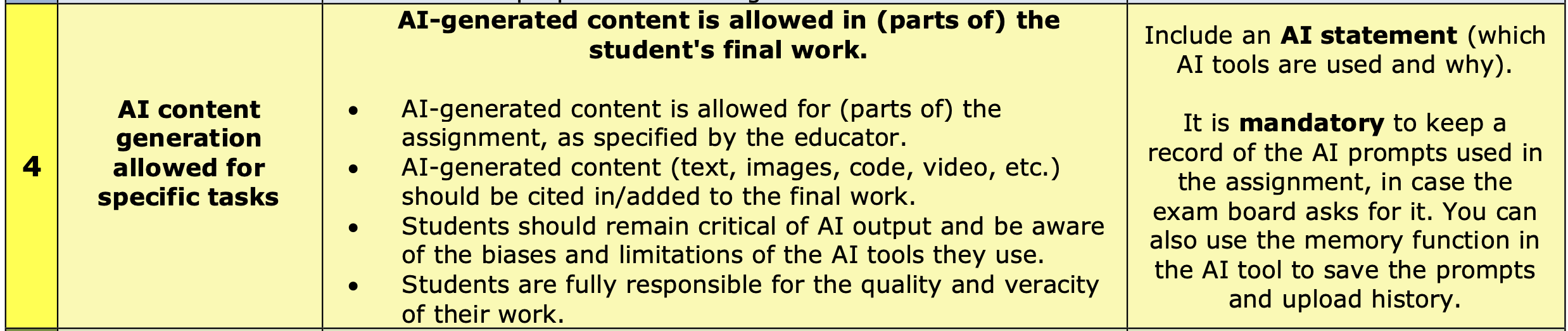
Use of Artificial Intelligence Within this course, the use of artificial intelligence (AI) is allowed up to level 4 as indicated in the AI guidelines of the university. For the practicals, the use of AI is permitted, but its use must be explicitly stated in the code. If you use a prompt to generate a piece of code, you must indicate this. Follow the rules as explained in the university’s AI index.
This is done as follows:
## AI was used to generate the following code using the prompt: make two random variables with a mean of zero, standard deviation of 1 and a 100 realistations using numpy
## Question 1
np.random.seed(1)
randomData_1 = np.random.normal(loc=0, scale=1, size=100)
randomData_2 = np.random.normal(loc=0, scale=1, size=100)
## Answer 1
## I think this is because x, y, z
....
You are 100% responsible for the code, and if it is incorrect, it is entirely your own responsibility. Additionally, we expect that you can explain and fully understand all code that has been generated. Excessive use without a valid AI declaration will result in the practical assignment being marked as not completed. A practical assignment will also be insufficient if the student cannot explain the generated code when asked by an instructor.
The use of AI is not allowed in the exams; however, students may use offline notes.
Absence
If you are unable to attend a computer practical, presentation session, or exam, you must inform the course coordinator before the start of the session to maintain active participation. If you cannot attend a mandatory session, always use the official form. See website: https://forms.uu.nl/universiteitutrecht-geo/AW_AbsenceForm. Active participation and attendance are required for every (online) component of the course.
See also: https://students.uu.nl/praktische-zaken/regelingen-en-procedures